All posts by crespootero

I am a computational chemist at University College London

Advanced Catalyst Design and Reactor Configuration Upgrade in Electrochemical Carbon Dioxide Conversion

Advanced Materials 2023

Electrochemical carbon dioxide reduction reaction (CO2RR) driven by renewable energy shows great promise in mitigating and potentially reversing the devastating effects of anthropogenic climate change and environmental degradation. The simultaneous synthesis of energy-dense chemicals can meet global energy demand while decoupling emissions from economic growth. However, the development of CO2RR technology faces challenges in catalyst discovery and device optimization that hinder their industrial implementation. In this contribution, we provide a comprehensive overview of the current state of CO2RR research, starting with the background and motivation for this technology, followed by the fundamentals and evaluated metrics. We then discuss the underlying design principles of electrocatalysts, emphasizing their structure–performance correlations and advanced electrochemical assembly cells that can increase CO2RR selectivity and throughput. Finally, we look to the future and identify opportunities for innovation in mechanism discovery, material screening strategies, and device assemblies to move toward a carbon-neutral society.
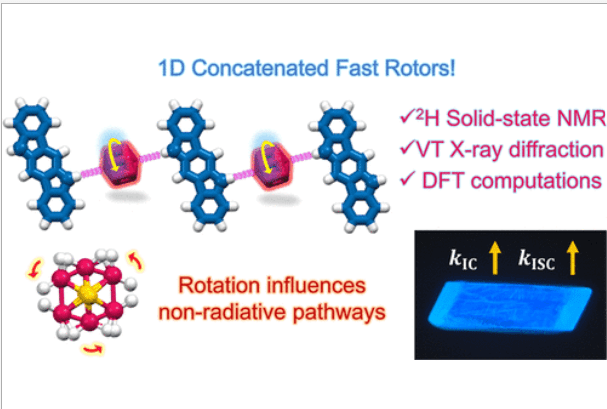
Indolocarbazole as a Platform for Concatenated Crystalline Rotors

Cryst. Growth Des. 2023

Herein, we describe a series of molecular rotors formed by cocrystallizing three indolo[3,2-b]carbazole (ICZ) derivatives with butyl and cyclohexyl substituents, along with 1,4-diaza[2.2.2]bicyclooctane (DABCO). The structures of rotors I and III were confirmed through single-crystal X-ray diffraction (SCXRD), revealing a concatenated 1D arrangement between the two components. Variable-temperature (VT) SCXRD experiments on rotors I and III suggested that the rotator shows rotational motion, with activation energies of 6.8 and 1.8 kcal mol–1, respectively. The lower activation energy for rotor III was attributed to the flexible environment around DABCO due to the presence of cyclohexyl groups, while the surroundings of rotor I were found to be more rigid. Additionally, our predictions of radiative and nonradiative decay constants indicate that the vibrations of the molecular rotors impact nonradiative decay rates and, consequently, the fluorescence quantum yields.

The role of copper in enhancing the performance of heteronuclear diatomic catalysts for the electrochemical CO2 conversion to C1 chemicals

Journal of Energy Chemistry 2023

Diatomic catalysts (DACs) with two adjacent metal atoms supported on graphene can offer diverse functionalities, overcoming the inherent limitations of single-atom catalysts (SACs). In this study, density functional theory calculations were conducted to investigate the reactivity of the carbon dioxide (CO2) reduction reaction (CO2RR) on metal sites of both DACs and SACs, as well as their synergistic effects on activity and selectivity. Calculation of the Gibbs free energies of CO2RR and associated values of the limiting potentials to generate C1 products showed that Cu acts as a promoter rather than an active catalytic centre in the catalytic CO2 conversion on heteronuclear DACs (CuN4-MN4), improving the catalytic activity on the other metal compared to the related SAC MN4. Cu enhances the initial reduction of CO2 by promoting orbital hybridization between the key intermediate *COOH 2p-orbitals and the metals 3d-orbitals around the Fermi level. This degree of hybridization in the DACs CuN4-MN4 decreases from Fe to Co, Ni, and Zn. Our work demonstrates how Cu regulates the CO2RR performance of heteronuclear DACs, offering an effective approach to designing practical, stable, and high-performing diatomic catalysts for CO2 electroreduction.

Multiconfigurational Calculations and Photodynamics Describe Norbornadiene Photochemistry

Journal of Organic Chemistry, 2023

Storing solar energy is a vital component of using renewable energy sources to meet the growing demands of the global energy economy. Molecular solar thermal (MOST) energy storage is a promising means to store solar energy with on-demand energy release. The light-induced isomerization reaction of norbornadiene (NBD) to quadricyclane (QC) is of great interest because of the generally high energy storage density (0.97 MJ kg–1) and long thermal reversion lifetime (t1/2,300K = 8346 years). However, the mechanistic details of the ultrafast excited-state [2 + 2]-cycloaddition are largely unknown due to the limitations of experimental techniques in resolving accurate excited-state molecular structures. We now present a full computational study on the excited-state deactivation mechanism of NBD and its dimethyl dicyano derivative (DMDCNBD) in the gas phase. Our multiconfigurational calculations and nonadiabatic molecular dynamics simulations have enumerated the possible pathways with 557 S2 trajectories of NBD for 500 fs and 492 S1 trajectories of DMDCNBD for 800 fs. The simulations predicted the S2 and S1 lifetimes of NBD (62 and 221 fs, respectively) and the S1 lifetime of DMDCNBD (190 fs). The predicted quantum yields of QC and DCQC are 10 and 43%, respectively. Our simulations also show the mechanisms of forming other possible reaction products and their quantum yields.

Modeling Excited States of Molecular Organic Aggregates for Optoelectronics

Annu. Rev. Phys. Chem. 2023

Light-driven phenomena in organic molecular aggregates underpin several mechanisms relevant to optoelectronic applications. Modelling these processes is essential for aiding the design of new materials and optimizing optoelectronic devices. In this review, we cover the use of different atomistic models, excited-state dynamics, and transport approaches for understanding light-activated phenomena in molecular aggregates, including radiative and nonradiative decay pathways. We consider both intra- and intermolecular mechanisms and focus on the role of conical intersections as facilitators of internal conversion. We explore the use of the exciton models for Frenkel and charge transfer states and the electronic structure methods and algorithms commonly applied for excited-state dynamics. Throughout the review, we analyze the approximations employed for the simulation of internal conversion, intersystem crossing, and reverse intersystem crossing rates and analyze the molecular processes behind single fission, triplet-triplet annihilation, Dexter energy transfer, and Förster energy transfer.

Conformational Emissive States in Dual-State Emitters with Benzotriazole Acceptors

Matter 2023

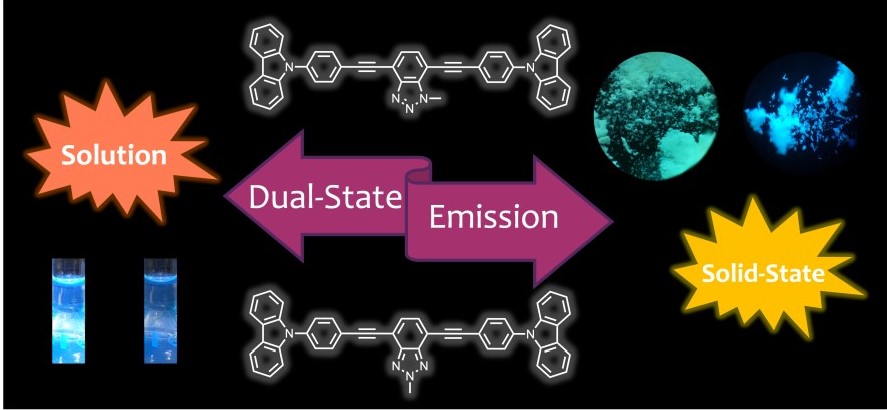
Dual-State Emission (DSE) refers to the emission of organic molecules in solution and solid-state and is an attractive but elusive property that has recently drawn significant interest. In this work, we report two conjugated compounds 1 and 2 that show good photoluminescence (PL) in solution (ФPL = 0.53 and ФPL = 0.43) and exceptional emission in the solid state (ФPL = 0.92 and ФPL = 0.84). To the best of our knowledge, this is the first report containing Donor-π-Acceptor-π-Donor (D-π-A-π-D) compounds with rotary components that adopt highly emissive states. We describe how the marked variations in PL in solution caused by changes in polarity and viscosity produce marked shifts in the emission. TD-DFT calculations indicate that these PL changes are facilitated by the existence of polarizable moieties within these rotatable molecules with the possibility of trapping in the higher energy S2 state. In the solid state, the flexibility and symmetry (or lack of it) in 1 and 2 play a crucial role producing strongly fluorescent twisted structures, as evidenced by their corresponding X-ray crystal arrays. Interestingly, the molecular torsion observed in the crystalline solids are different from those observed in solution. We attribute this novel DSE behavior to the molecular rotor D-π-A-π-D architecture that provides conformational and electronic flexibility for the systems to respond to the changes in the environment.

Single-Atom Iridium on Hematite Photoanodes for Solar Water Splitting: Catalyst or Spectator?

J. Am. Chem. Soc. 2023, Just Accepted

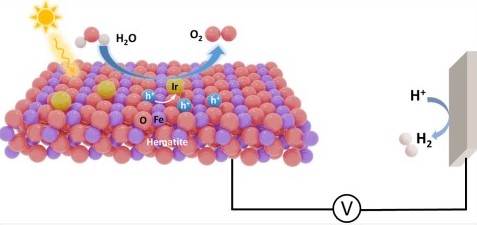
Single-atom catalysts (SACs) on hematite photoanodes are efficient cocatalysts to boost photoelectrochemical performance. They feature high atom utilization, remarkable activity, and distinct active sites. However, the specific role of SACs on hematite photoanodes is not fully understood yet: Do SACs behave as a catalytic site or as a spectator? By combining spectroscopic experiments and computer simulations, we demonstrate that single-atom iridium (sIr) catalysts on hematite (α-Fe2O3/sIr) photoanodes act as a true catalyst by trapping holes from hematite and providing active sites for the water oxidation reaction. In situ transient absorption spectroscopy showed a reduced number of holes and shortened hole lifetime in the presence of sIr. This was particularly evident on the second timescale, indicative of fast hole transfer and depletion toward water oxidation. Intensity-modulated photocurrent spectroscopy evidenced a faster hole transfer at the α-Fe2O3/sIr/electrolyte interface compared to that at bare α-Fe2O3. Density functional theory calculations revealed the mechanism for water oxidation using sIr as a catalytic center to be the preferred pathway as it displayed a lower onset potential than the Fe sites. X-ray photoelectron spectroscopy demonstrated that sIr introduced a mid-gap of 4d state, key to the fast hole transfer and hole depletion. These combined results provide new insights into the processes controlling solar water oxidation and the role of SACs in enhancing the catalytic performance of semiconductors in photo-assisted reactions.

Photochemical Fingerprinting Is a Sensitive Probe for the Detection of Synthetic Cannabinoid Receptor Agonists; toward Robust Point of-Care Detection

Anal. Chem. 2023. Accepted Manuscript

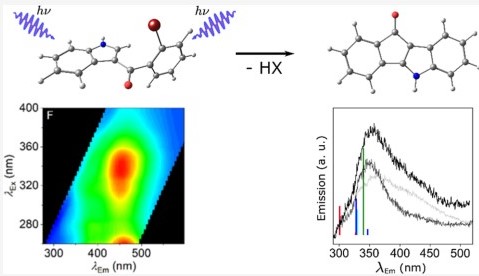
With synthetic cannabinoid receptor agonist (SCRA) use still prevalent across Europe and structurally advanced generations emerging, it is imperative that drug detection methods advance in parallel. SCRAs are a chemically diverse and evolving group, which makes rapid detection challenging. We have previously shown that fluorescence spectral fingerprinting (FSF) has the potential to provide rapid assessment of SCRA presence directly from street material with minimal processing and in saliva. Enhancing the sensitivity and discriminatory ability of this
approach has high potential to accelerate the delivery of a pointof-care technology that can be used confidently by a range of stakeholders, from medical to prison staff. We demonstrate that a range of structurally distinct SCRAs are photochemically active and give rise to distinct FSFs after irradiation. To explore this in detail, we have synthesized a model series of compounds which mimic specific structural features of AM-694. Our data show that FSFs are sensitive to chemically conservative changes, with evidence that this relates to shifts in the electronic structure and cross-conjugation. Crucially, we find that the photochemical degradation rate is sensitive to individual structures and gives rise to a specific major product, the mechanism and identification of which we elucidate through density-functional theory (DFT) and time-dependent DFT. We test the potential of our hybrid “photochemical
fingerprinting” approach to discriminate SCRAs by demonstrating SCRA detection from a simulated smoking apparatus in saliva. Our study shows the potential of tracking photochemical reactivity via FSFs for enhanced discrimination of SCRAs, with successful integration into a portable device

Competition between ultralong organic phosphorescence and thermally activated delayed fluorescence in dichloro derivatives of 9-benzoylcarbazole

Physical Chemistry Chemical Physics, Just accepted 2022

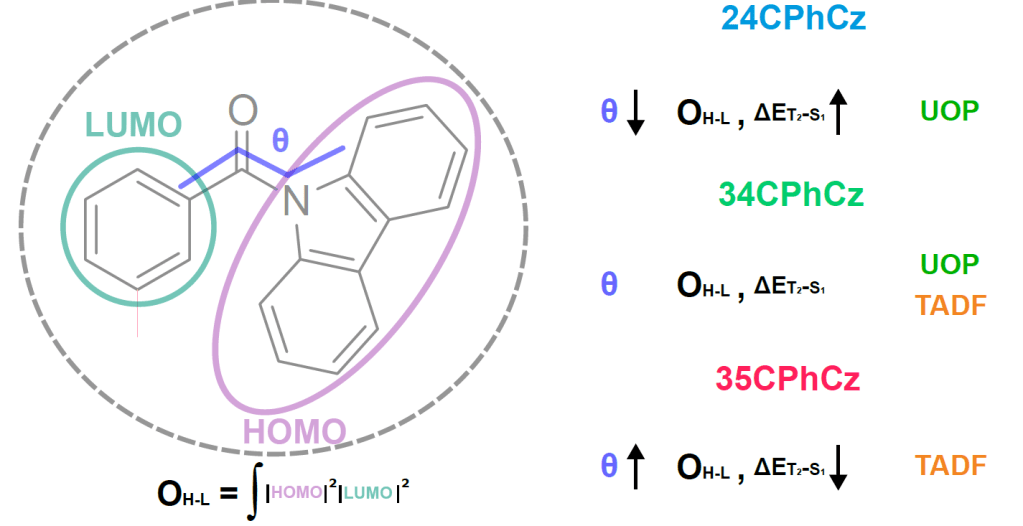
Optoelectronic materials based on metal-free organic molecules represent a promising alternative to traditional inorganic devices. Significant attention has been devoted to the development of the third generation of OLEDs which are based on the temperature-activated delayed fluorescence (TADF) mechanism. In the last few years, several materials displaying ultra-long organic phosphorescence (UOP) have been designed using strategies such as crystal engineering and halogen functionalisation. Both TADF and UOP are controlled by the population of triplet states and the energy gaps between the singlet and triplet manifolds. In this paper, we explore the competition between TADF and UOP in the molecular crystals of three dichloro derivatives of 9H-carbazol-3-yl(phenyl)methanone. We investigate the excited state mechanisms in solution and the crystalline phase and address the effects of exciton transport and temperature on the rates of direct and reverse intersystem crossing under the Marcus-Levich-Jortner model. We also analyse how the presence of isomeric impurities and the stabilisation of charge transfer states affect these processes. Our simulations explain the different mechanisms observed for the three derivatives and highlight the role of intramolecular rotation and crystal packing in determining the energy gaps. This work contributes to a better understanding of the connection between chemical and crystalline structures that will enable the design of efficient materials.

Newton-X Platform: New Software Developments for Surface Hopping and Nuclear Ensembles

J. Chem. Theory Comput. 2022, Just Accepted

Newton-X is an open-source computational platform to perform nonadiabatic molecular dynamics based on surface hopping and spectrum simulations using the nuclear ensemble approach. Both are among the most common methodologies in computational chemistry for photophysical and photochemical investigations. This paper describes the main features of these methods and how they are implemented in Newton-X. It emphasizes the newest developments, including zero-point-energy leakage correction, dynamics on complex-valued potential energy surfaces, dynamics induced by incoherent light, dynamics based on machine-learning potentials, exciton dynamics of multiple chromophores, and supervised and unsupervised machine learning techniques. Newton-X is interfaced with several third-party quantum-chemistry programs, spanning a broad spectrum of electronic structure methods.