
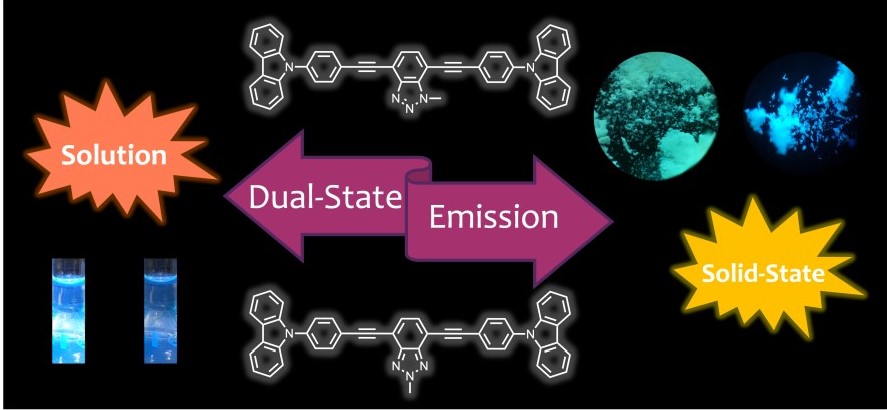
Dual-State Emission (DSE) refers to the emission of organic molecules in solution and solid-state and is an attractive but elusive property that has recently drawn significant interest. In this work, we report two conjugated compounds 1 and 2 that show good photoluminescence (PL) in solution (ФPL = 0.53 and ФPL = 0.43) and exceptional emission in the solid state (ФPL = 0.92 and ФPL = 0.84). To the best of our knowledge, this is the first report containing Donor-π-Acceptor-π-Donor (D-π-A-π-D) compounds with rotary components that adopt highly emissive states. We describe how the marked variations in PL in solution caused by changes in polarity and viscosity produce marked shifts in the emission. TD-DFT calculations indicate that these PL changes are facilitated by the existence of polarizable moieties within these rotatable molecules with the possibility of trapping in the higher energy S2 state. In the solid state, the flexibility and symmetry (or lack of it) in 1 and 2 play a crucial role producing strongly fluorescent twisted structures, as evidenced by their corresponding X-ray crystal arrays. Interestingly, the molecular torsion observed in the crystalline solids are different from those observed in solution. We attribute this novel DSE behavior to the molecular rotor D-π-A-π-D architecture that provides conformational and electronic flexibility for the systems to respond to the changes in the environment.
 The Crespo-Otero Research Group