Category Archives: Recent papers

Asymmetric Dual-State Emitters Featuring Thiazole Acceptors

EurJOC. 2022. Just accepted.

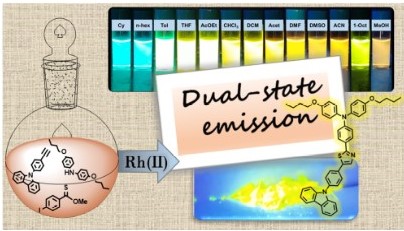
This work describes a new approach to construct highly conjugated molecules with asymmetric donor-acceptor-donor’ architectures (D-A-D’). Five new emissive compounds featuring thiazole, a scarcely used acceptor, were synthesized using a three-component Rh(II) catalytic reaction. The asymmetric fluorescent compounds show significant emission in solution (QY = 73% – 100%) and the solid-state (QY = 14% – 59%), and therefore considered Dual-State Emitters (DSE). We also evaluate the impact of O-alkyl chains with varying lengths in the photophysical properties in solution, aggregates, and solid-state. Computational studies indicate that the involved electronic transitions have a significant charge transfer character produced almost exclusively from the triphenylamine donors. According to the single crystal X-ray data of compounds 8 and 9, the conjugated structures have a twisted molecular conformation that contributes to the observed emission in the solid-state. These findings show a systematic approach to design DSE materials, which may help to stimulate their use in biological or optoelectronic applications.

Porous Nanographene Formation on γ-Alumina Nanoparticles via Transition-Metal-Free Methane Activation

Chem. Sci., 2022, Accepted Manuscript

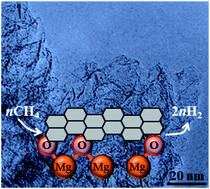
γ-Al2O3 nanoparticles promote pyrolytic carbon deposition of CH4 at temperatures higher than 800°C to give single-walled nanoporous graphene (NPG) materials without the need for transition metals as reaction centers. To accelerate the development of efficient reactions for NPG synthesis, we have investigated early-stage CH4 activation for NPG formation on γ-Al2O3 nanoparticles via reaction kinetics and surface analysis. The formation of NPG was promoted at oxygen vacancies on (100) surfaces of γ-Al2O3 nanoparticles following surface activation by CH4. The kinetic analysis was well corroborated by a computational study using density functional theory. Surface defects generated as a result of surface activation by CH4 make it kinetically feasible to obtain single-layered NPG, demonstrating the importance of precise control of oxygen vacancies for carbon growth.

Understanding the solid state luminescence and piezochromic properties in polymorphs of an anthracene derivative

Phys. Chem. Chem. Phys., 2022, Advance Article

Luminescent molecular crystals have gained significant research interest for optoelectronic applications. However, fully understanding their structural and electronic relationships in the condensed phase and under external stimuli remains a significant challenge. Here, piezochromism in the molecular crystal 9,10-bis((E)-2-(pyridin-4-yl)vinyl)anthracene (BP4VA) is studied using a combination of density functional theory (DFT) and time-dependent TD-DFT. We investigate the effects that molecular packing and geometry have on the electronic and phonon structure and the excited state properties in this archetypal system. We find that the luminescence properties are red-shifted with the transition from a herringbone to a sheet packing arrangement. An almost continuous red-shift in the band gap is found with the application of an external pressure through the enhancement of π–π and CH–π interactions, and is a mechanism in fine tuning an emissive response. The analysis of the phonon structure of the molecular crystal suggests restriction of motion in the herringbone packing arrangement, with motion restricted at higher pressure. This is supported by the Huang–Rhys factors which show a decrease in the reorganisation energy with the application of pressure. Ultimately, a balance between the decrease in reorganisation energies and the increase in exciton coupling will determine whether nonradiative decay is enhanced or decreased with the increase in pressure in these systems.
Emission Quenching in Tetraphenylfuran Crystal: Why This Propeller-Shaped Molecule Does Not Emit in the Condensed Phase

Molecules 2022, 27(2), 522

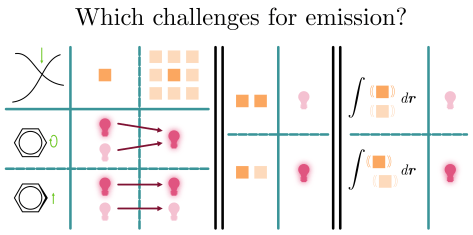
Due to their substantial fluorescence quantum yields in the crystalline phase, propeller-shaped molecules have recently gained significant attention as potential emissive materials for optoelectronic applications. For the family of cyclopentadiene derivatives, light-emission is highly dependent on the nature of heteroatomic substitutions. In this paper, we investigate excited state relaxation pathways in the tetraphenyl-furan molecule (TPF), which in contrast with other molecules in the family, shows emission quenching in the solid-state. For the singlet manifold, our calculations show nonradiative pathways associated with C-O elongation are blocked in both vacuum and the solid state. A fraction of the population can be transferred to the triplet manifold and, subsequently, to the ground state in both phases. This process is expected to be relatively slow due to the small spin-orbit couplings between the relevant singlet-triplet states. Emission quenching in crystalline TPF seems to be in line with more efficient exciton hopping rates. Our simulations help clarify the role of conical intersections, population of the triplet states and crystalline structure in the emissive response of propeller-shaped molecules.

Triplet Generation Dynamics in Si- and Ge-Bridged Conjugated Copolymers

J. Phys. Chem. C 2022, Just Accepted

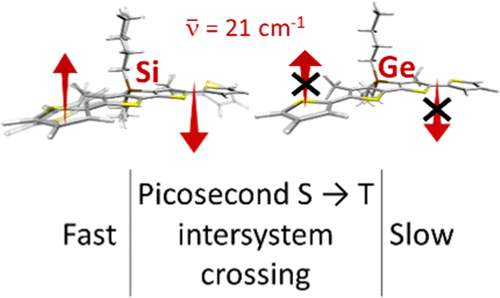
The effect of incorporating Si and Ge atoms in the conjugated backbone of semiconductor polymers is investigated using transient absorption spectroscopy and quantum chemical calculations to uncover the heavy-atom impact on the excited-state dynamics in neat films and polymer/fullerene blends. The singlet and triplet exciton dynamics of the copolymers are resolved and the time constant of intersystem crossing (ISC) of dithienosilole is found to be 6.98 ± 0.45 ps and nearly 4 times longer than that of dithienogermole. This result indicates that factors other than the heavy-atom effect govern the ISC rates and the overall excited-state dynamics in the copolymers. Our quantum chemical calculations and estimates of the ISC rates based on the semiclassical derivation for the electron-transfer processes in the nonadiabatic limit reveal that the main driver for the increased ISC time constant in BuSiDT is the reduction in planarity and increased torsional out-of-plane vibration of the Si-bridged thiophenes in the dithienosilole compared to the dithienogermole, leading to 8.3 times higher spin–orbit coupling and consequently a higher ISC rate. In the polymer/fullerene blends, charge generation yields are estimated. The results from this study indicate that the incorporation of heavy atoms in a bridge position within the conjugated polymer backbone can be used as a synthetic strategy to fine-tune excited-state properties.

Excited state mechanisms in crystalline carbazole: the role of aggregation and isomeric defects

J. Mater. Chem. C, 2021,9, 11882-11892

The molecule of Carbazole (Cz) is commonly used as a building block in organic materials for optoelectronic applications, acting as light-absorbing, electron donor and emitting moiety. Crystals from Cz and derivatives display ultralong phosphorescence at room temperature. However, different groups have reported inconsistent quantum efficiencies for the same compounds. In a recent experimental study by Liu et al (Nature Materials 2021, 20, 175-180), the ultralong phosphoresce properties of Cz has been associated with the presence of small fractions of isomeric impurities from commercially available Cz. In this paper, we use state-of-the-art computational approaches to investigate light-induced processes in crystalline and doped Cz. We revisited the role of aggregation and isomeric impurities on the excited state pathways and analyse the mechanisms for exciton, Dexter energy transfer and electron transport based on Marcus and Marcus-Levich-Jortner theories. Our excited state mechanisms provide a plausible interpretation for the experimental results and support the formation of charge-separated states at the defect/Cz molecular interface. These results contribute to a better understanding of the factors enhancing the excited state lifetimes in organic materials and the role of doping with organic molecules.

Synthesis of graphene mesosponge via catalytic methane decomposition on magnesium oxide

J. Mater. Chem. A, 2021. Just Accepted

Graphene mesosponge (GMS) is a new class of mesoporous carbon consisting mainly of single-layer graphene walls. GMS has traditionally been synthesized via chemical vapour deposition (CVD) of methane onto a template of alumina (Al2O3) nanoparticles, which catalyses methane conversion. However, the Al2O3 template needs to be removed using costly and environmentally concerning processes such as hydrofluoric acid or concentrated base. In this work, we examine methane conversion catalysed by magnesium oxide (MgO) and utilized MgO as an alternative catalytic template. In contrast to Al2O3, a solid acid catalyst, MgO is a solid base catalyst that is also active for methane conversion into graphene sheets but dissolves easily in hydrochloric acid. We have investigated the reaction mechanism using in situ weight measurements and gas-emission analysis during CVD complemented by density functional theory calculations. We found that the pure MgO surface is activated via O-elimination with methane above 778 °C. On the activated MgO surface, methane is converted into a graphene sheet with a relatively low activation energy of 134 kJ mol−1. Once the first graphene layer is formed, the methane-to-graphene conversion rate decreases and the activation energy increases to 234 kJ mol−1, which is comparable to that reported in thermal methane-CVD on carbon. As a result of the faster growth rate of the first layer with respect to additional layers, it is easier to obtain single-graphene layers using MgO. The MgO-derived GMS has a unique combination of properties including a high surface area, developed mesopores, high oxidation resistance, significant softness and elasticity, very low bulk modulus (0.05 GPa), and force-driven reversible liquid–gas phase transition. Thus, we expect the MgO-derived GMS can be employed in a variety of applications including high-voltage supercapacitors and as a new type of heat pump based on the force-driven phase transition.

Rotaxane CoII Complexes as Field‐Induced Single‐Ion Magnets

Angew. Chem. Int. Ed. 2021. Just Accepted

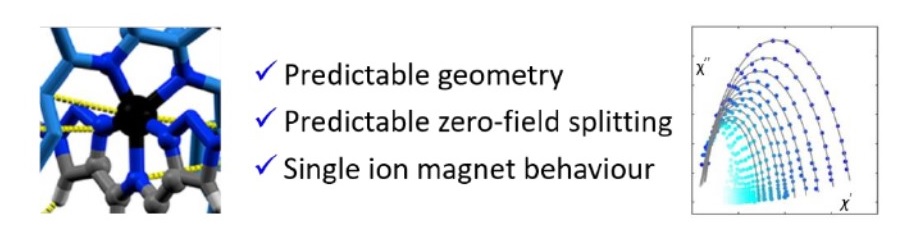
Mechanically chelating ligands have untapped potential for the engineering of metal ion properties by providing reliable control of the number, nature and geometry of donor atoms, akin to how a protein cavity controls the properties of bound metal ions. Here we demonstrate this principle in the context of Co II ‐based single‐ion magnets. Using multi‐frequency EPR, susceptibility and magnetization measurements we found that these complexes show some of the highest zero field splittings reported for five‐coordinate Co II complexes to date. The predictable coordination behavior of the interlocked ligands allowed the magnetic properties of their Co II complexes to be evaluated computationally a priori and our combined experimental and theoretical approach enabled us to rationalize the observed trends. The predictable magnetic behavior of the rotaxane Co II complexes demonstrates that interlocked ligands offer a new strategy to design metal complexes with interesting functionality.

Protect to detect: A Golgi apparatus targeted probe to image mobile zinc through the use of a lipophilic cell-labile protecting group strategy

Sensors and Actuators B: Chemical. 2021, 338,129850.

The Golgi apparatus requires zinc for its normal function, but the role it plays in these processes at the sub-cellular level is not well-understood due to the lack of appropriate tools to image it. Herein, a small molecule Golgi apparatus targeted probe was developed to image mobile Zn2+. A trityl group was used to protect a Golgi apparatus targeting cysteine residue to increase cell membrane permeability, which was then removed within 24 h, revealing the free cysteine targeting motif to anchor the probe to the Golgi apparatus. The probe shows good photophysical properties, good selectivity and Zn2+ response over a wide range of pH as well as low cellular toxicity. The probe was shown to be capable of targeting the Golgi apparatus and responding to Zn2+ in a number of different cell lines and was also applied to monitor the change of concentration of mobile Zn2+ in the Golgi apparatus in response to oxidative stress.

Role of Conical Intersections on the Efficiency of Fluorescent Organic Molecular Crystals

J. Phys. Chem. A 2021, 125, 4, 1012–1024

Organic molecular crystals are attractive materials for luminescent applications because of their promised tunability. However, the link between the chemical structure and emissive behavior is poorly understood because of the numerous interconnected factors which are at play in determining radiative and nonradiative behaviors at the solid-state level. In particular, the decay through conical intersection dominates the nonadiabatic regions of the potential energy surface, and thus, their accessibility is a telling indicator of the luminosity of the material. In this study, we investigate the radiative mechanism for five organic molecular crystals which display a solid-state emission, with a focus on the role of conical intersections in their photomechanisms. The objective is to situate the importance of the accessibility of conical intersections with regards to emissive behavior, taking into account other nonradiative decay channels, namely, vibrational decay, and exciton hopping. We begin by giving a brief overview of the structural patterns of the five systems within a larger pool of 13 crystals for a richer comparison. We observe that because of the prevalence of sheet like and herringbone packing in organic molecular crystals, the conformational diversity of crystal dimers is limited. Additionally, similarly spaced dimers have exciton coupling values of a similar order within a 50 meV interval. Next, we focus on three exemplary cases, where we disentangle the role of nonradiative decay mechanisms and show how rotational minimum energy conical intersections in vacuum lead to puckered ones in the crystal, increasing their instability upon crystallization in typical packing motifs. In contrast, molecules with puckered conical intersections in vacuum tend to conserve this trait upon crystallization, and therefore, their quantum yield of fluorescence is determined predominantly by other nonradiative decay mechanisms.