Category Archives: Recent papers

Theoretical Insights into the Role of Defects in the Optimization of the Electrochemical Capacitance of Graphene

Energy Materials and Devices 2024

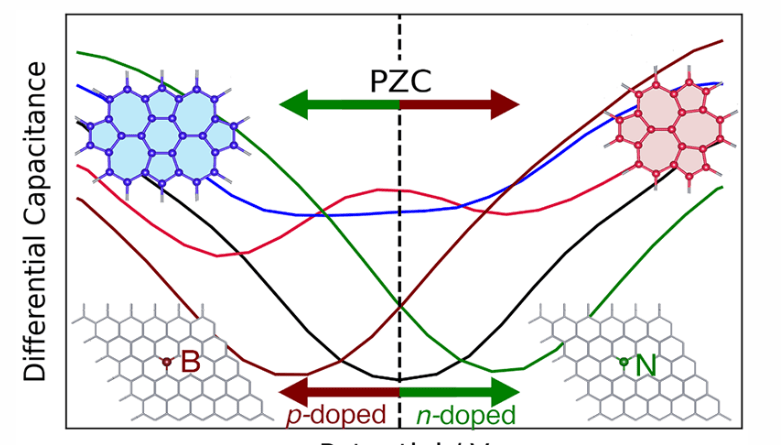
Graphene-based frameworks suffer from a low quantum capacitance due to graphene’s Dirac point at the Fermi level. This theoretical study investigated the effect structural defects, nitrogen and boron doping, and surface epoxy/hydroxy groups have on the electronic structure and capacitance of graphene. Density functional theory calculations reveal that the lowest energy configurations for nitrogen or boron substitutional doping occur when the dopant atoms are segregated. This elucidates why the magnetic transition for nitrogen doping is experimentally only observed at higher doping levels. We also highlight that the lowest energy configuration for a single vacancy defect is magnetic. Joint density functional theory calculations show that the fixed band approximation becomes increasingly inaccurate for electrolytes with lower dielectric constants. The introduction of structural defects rather than nitrogen or boron substitutional doping, or the introduction of adatoms leads to the largest increase in density of states and capacitance around graphene’s Dirac point. However, the presence of adatoms or substitutional doping leads to a larger shift of the potential of zero charge away from graphene’s Dirac point.

Synthesis of graphene mesosponge using CaO nanoparticles formed from CaCO3

Catalysis Today 2024

While graphene mesosponge (GMS) is a new type of mesoporous material with the potential for a variety of applications, its synthesis process requires costly templates such as Al2O3 and MgO nanoparticles. In this study, we present a new synthesis method for GMS, which achieves a high specific surface area of 1720 m2 gsingle bond1 by employing calcium oxide (CaO) nanoparticles as templates. The CaO nanoparticles with an approximate diameter of 86 nm are formed through the thermal decomposition of calcium carbonate nanoparticles. However, the calcium carbonate nanoparticles contain a small amount of Mg (2 wt %), and the thermal decomposition process also yields impurities, including Mg. When the CaO nanoparticles, including the Mg-based impurities, are subjected to chemical vapor deposition, the CaO surface can be coated with a thin carbon layer, primarily consisting of single-layer graphene through the specific catalysis of the CaO surface in facilitating the CH4-to-C conversion reactions. However, at the same time, the presence of Mg-based impurities leads to the formation of low-crystalline carbons, which have a detrimental effect on the subsequent high-temperature annealing at 1800 °C, following the template removal process, resulting in an excessive number of edge sits in the GMS. We have found that the harmful low-crystalline carbons can be eliminated through heat treatment in air at 350 °C. By adopting such a removal process, high-quality GMS with a minimal number of edge sites can be produced.
Molecular graph transformer: stepping beyond ALIGNN into long-range interactions


Digital Discovery, 2024,3, 1048-1057

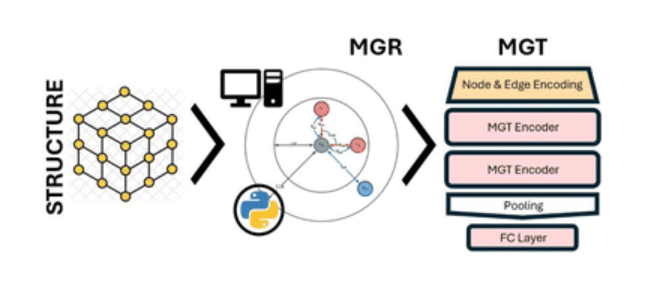
Graph Neural Networks (GNNs) have revolutionized material property prediction by learning directly from the structural information of molecules and materials. However, conventional GNN models rely solely on local atomic interactions, such as bond lengths and angles, neglecting crucial long-range electrostatic forces that affect certain properties. To address this, we introduce the Molecular Graph Transformer (MGT), a novel GNN architecture that combines local attention mechanisms with message passing on both bond graphs and their line graphs, explicitly capturing long-range interactions. Benchmarking on MatBench and Quantum MOF (QMOF) datasets demonstrates that MGT’s improved understanding of electrostatic interactions significantly enhances the prediction accuracy of properties like exfoliation energy and refractive index, while maintaining state-of-the-art performance on all other properties. This breakthrough paves the way for the development of highly accurate and efficient materials design tools across diverse applications.

Fast and accurate nonadiabatic molecular dynamics enabled through variational interpolation of correlated electron wavefunctions

Faraday Discuss., 2024, Accepted Manuscript

We build on the concept of eigenvector continuation to develop an efficient multi-state method for the rigorous and smooth interpolation of a small training set of many-body wavefunctions through chemical space at mean-field cost. The inferred states are represented as variationally optimal linear combinations of the training states transferred between the many-body basis of different nuclear geometries. We show that analytic multi-state forces and nonadiabatic couplings from the model enable application to nonadiabatic molecular dynamics, developing an active learning scheme to ensure a compact and systematically improvable training set. This culminates in application to the nonadiabatic molecular dynamics of a photoexcited 28-atom hydrogen chain, with surprising complexity in the resulting nuclear motion. With just 22 DMRG calculations of training states from the low-energy correlated electronic structure at different geometries, we infer the multi-state energies, forces and nonadiabatic coupling vectors at 12,000 geometries with provable convergence to high accuracy along an ensemble of molecular trajectories, which would not be feasible with a brute force approach. This opens up a route to bridge the timescales between accurate single-point correlated electronic structure methods and timescales of relevance for photo-induced molecular dynamics.

A thermodynamically favorable route to the synthesis of nanoporous graphene templated on CaO via chemical vapor deposition


Green Chem., 2024,26, 6051-6062

Template-assisted chemical vapor deposition (CVD) is a promising approach for fabricating nanoporous materials based on graphene walls. Among conventional metal oxide templates, CaO, produced through the thermal decomposition of CaCO3, offers improved environmental sustainability and lower production costs, thereby potentially making it a viable candidate for green template materials. Nevertheless, the underlying reaction mechanisms of the interaction on the CaO surface during the CVD process remain indeterminate, giving rise to challenges in regulating graphene formation and obtaining high-quality materials. In this work, a comprehensive experimental–theoretical investigation has unveiled the CVD mechanism on CaO. CaO exhibits efficient catalytic activity in the dissociation of CH4, thereby facilitating a thermodynamically favorable conversion of CH4 to graphene. These findings highlight the potential of using CaO as a substrate for graphene growth, combining both sustainability and cost-effectiveness. When the shell-like graphene layer deposited on CaO particles is released through the dissolution of CaO with HCl, the resulting nanoporous graphene-based materials can be readily compacted by the capillary force of the liquid upon drying. The folded surfaces, however, can become available for electric double-layer capacitance via electrochemical exfoliation under a low applied potential (<1.2 V vs. Ag/AgClO4).

Solar-Driven Cellulose Photorefining into Arabinose over Oxygen-Doped Carbon Nitride

ACS Catal. 2024, 14, 5, 3376–3386

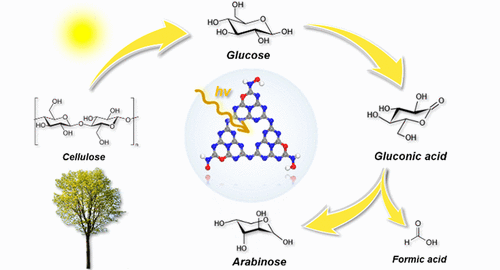
Biomass photorefining is a promising strategy to address the energy crisis and transition toward carbon carbon-neutral society. Here, we demonstrate the feasibility of direct cellulose photorefining into arabinose by a rationally designed oxygen-doped polymeric carbon nitride, which generates favorable oxidative species (e.g., O2OH) for selective oxidative reactions at neutral conditions. In addition, we also illustrate the mechanism of the photocatalytic cellulose to arabinose conversion by density functional theory calculations. The oxygen insertion derived from oxidative radicals at the C1 position of glucose within cellulose leads to oxidative cleavage of β-1,4 glycosidic linkages, resulting in the subsequent gluconic acid formation. The following decarboxylation process of gluconic acid via C1–C2 α-scissions, triggered by surface oxygen-doped active sites, generates arabinose and formic acid, respectively. This work not only offers a mechanistic understanding of cellulose photorefining to arabinose but also sets up an example for illuminating the path toward direct cellulose photorefining into value-added bioproducts under mild conditions.

Performance of point charge embedding schemes for excited states in molecular organic crystals 

J. Chem. Phys. 2023, 159, 244108

Modeling excited state processes in molecular crystals is relevant for several applications. A popular approach for studying excited state molecular crystals is to use cluster models embedded in point charges. In this paper, we compare the performance of several embedding models in predicting excited states and S1–S0 optical gaps for a set of crystals from the X23 molecular crystal database. The performance of atomic charges based on ground or excited states was examined for cluster models, Ewald embedding, and self-consistent approaches. We investigated the impact of various factors, such as the level of theory, basis sets, embedding models, and the level of localization of the excitation. We consider different levels of theory, including time-dependent density functional theory and Tamm–Dancoff approximation (TDA) (DFT functionals: ωB97X-D and PBE0), CC2, complete active space self-consistent field, and CASPT2. We also explore the impact of selection of the QM region, charge leakage, and level of theory for the description of different kinds of excited states. We implemented three schemes based on distance thresholds to overcome overpolarization and charge leakage in molecular crystals. Our findings are compared against experimental data, G0W0-BSE, periodic TDA, and optimally tuned screened range-separated functionals.

Silicon Radical-Induced CH4 Dissociation for Uniform Graphene Coating on Silica Surface

Small, 2023, 2306325

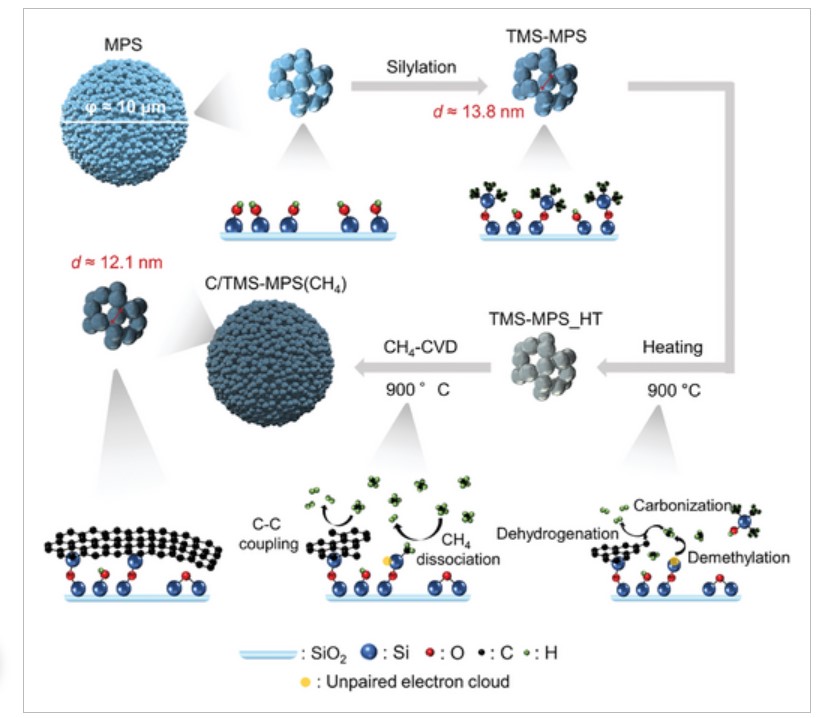
Due to the manufacturability of highly well-defined structures and wide-range versatility in its microstructure, SiO2 is an attractive template for synthesizing graphene frameworks with the desired pore structure. However, its intrinsic inertness constrains the graphene formation via methane chemical vapor deposition. This work overcomes this challenge by successfully achieving uniform graphene coating on a trimethylsilyl-modified SiO2 (denote TMS-MPS). Remarkably, the onset temperature for graphene growth dropped to 720 °C for the TMS-MPS, as compared to the 885 °C of the pristine SiO2. This is found to be mainly from the Si radicals formed from the decomposition of the surface TMS groups. Both experimental and computational results suggest a strong catalytic effect of the Si radicals on the CH4 dissociation. The surface engineering of SiO2 templates facilitates the synthesis of high-quality graphene sheets. As a result, the graphene-coated SiO2 composite exhibits a high electrical conductivity of 0.25 S cm−1. Moreover, the removal of the TMP-MPS template has released a graphene framework that replicates the parental TMS-MPS template on both micro- and nano- scales. This study provides tremendous insights into graphene growth chemistries as well as establishes a promising methodology for synthesizing graphene-based materials with pre-designed microstructures and porosity.

Simulating excited states in metal organic frameworks: from light-absorption to photochemical CO2 reduction

Materials Advances 2023

Metal–organic frameworks (MOFs) have a wide range of optoelectronic and photochemical applications, many of which are directly dependent on their excited states. Computational modelling of excited state processes could aid the rational design of effective catalysts, but simulating MOFs in their excited state is challenging. This is due to the inherent molecule/crystal duality of MOFs, their large and diverse unit cells, and the unfavourable scalability of quantum chemical methods. However, periodic and cluster models have been developed and applied to characterise the excited states of MOFs and their properties, such as charge transfer, luminescence, and photocatalytic mechanisms. Additionally, embedding techniques provide a means of explicitly incorporating the crystal environment in such models. Although many high-quality reviews have assessed computational modelling in MOFs, most have focused on the study of ground-state electronic properties. In this perspective, we focus on the computational methods available to describe the excited states of MOFs from the molecular, periodic, and embedding perspectives. To illustrate the performance of cluster and periodic models, we compare the results obtained using both approaches at different levels of theory for an exemplary MOF. We also analyse examples from modelling relevant photochemical and photophysical including charge transfer, exciton effects, chemosensing, host–guest mechanisms, thermally activated delayed fluorescence and room temperature phosphorescence. Additionally, we show how such methods can be applied to predict MOF-based photocatalytic CO2 reduction to value-added chemicals. We emphasise the advantages and limitations of current methodologies, as well as the potential for utilising databases and machine learning models in this context.

Advanced Catalyst Design and Reactor Configuration Upgrade in Electrochemical Carbon Dioxide Conversion

Advanced Materials 2023

Electrochemical carbon dioxide reduction reaction (CO2RR) driven by renewable energy shows great promise in mitigating and potentially reversing the devastating effects of anthropogenic climate change and environmental degradation. The simultaneous synthesis of energy-dense chemicals can meet global energy demand while decoupling emissions from economic growth. However, the development of CO2RR technology faces challenges in catalyst discovery and device optimization that hinder their industrial implementation. In this contribution, we provide a comprehensive overview of the current state of CO2RR research, starting with the background and motivation for this technology, followed by the fundamentals and evaluated metrics. We then discuss the underlying design principles of electrocatalysts, emphasizing their structure–performance correlations and advanced electrochemical assembly cells that can increase CO2RR selectivity and throughput. Finally, we look to the future and identify opportunities for innovation in mechanism discovery, material screening strategies, and device assemblies to move toward a carbon-neutral society.