Metal-free organic crystals with room-temperature phosphorescence (RTP) present an innovative alternative to conventional inorganic materials for optoelectronic applications and sensing. Recently, substantial attention has been directed towards the design of new phosphorescent crystals through crystal engineering and functionalisation. In this paper, we investigate the excited-state deactivation mechanisms of two simple organic molecules: terephthalic acid (TPA) and isophthalic acid (IPA) using embedding models based on multiconfigurational MS-CASPT2 calculations. These molecules exhibit prompt and delayed fluorescence and RTP in the solid state. We explore intramolecular internal conversion pathways using high-level quantum chemistry methods in both solution and crystalline phases. We analyse deactivation mechanisms involving singlet and triplet states, quantifying direct and reverse intersystem crossing rates from the lowest triplet states, as well as fluorescence and phosphorescence rates. Additionally, our study examines singlet exciton transport in single crystals of TPA and IPA. Our findings clarify the mechanisms underlying the prompt and delayed fluorescence and RTP of crystalline TPA and IPA, revealing distinct differences in their deactivation processes. Notably, we explain the enhanced fluorescence and phosphorescence in IPA compared to TPA, emphasising how the positioning of the carboxylic group influences electronic delocalisation in excited states, (de)stabilising delocalised ππ* states along the reaction coordinate, thereby significantly impacting deactivation mechanisms.
Category Archives: Recent papers
Designing molecular and two-dimensional metalloporphyrin catalysts for the electrochemical CO2 reduction reaction
Catal. Sci. Technol., 2025, 15, 3157-3170
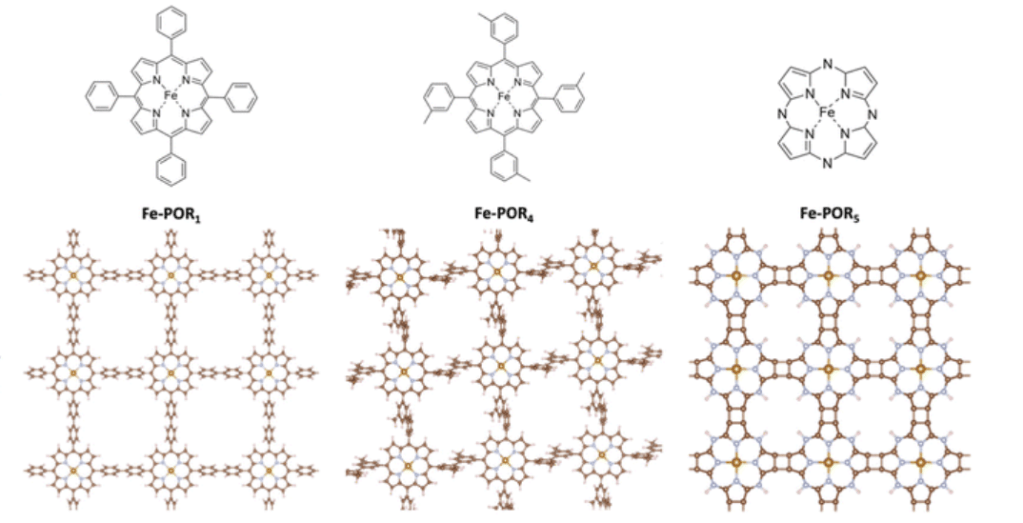
The electrochemical CO2 reduction reaction (eCO2R) is an important route toward the sustainable conversion of CO2 to value-added chemicals. However, developing efficient catalysts with high selectivity and stability remains challenging. Metalloporphyrins (M–PORs) represent an attractive class of molecular catalysts because their structural framework offers a unique combination of tunability of the peripheral ligands, flexibility of the metal centre, and versatility of the oxidation state of the metal. These properties can be exploited to tailor the catalytic properties of M–PORs for the eCO2R. Here, we present a comprehensive computational study using density functional theory to systematically explore M–POR catalysts with varying metal centers (Ni, Fe, Cu, Co), oxidation states, and anchoring ligands, aimed at enhancing the selective production of the C1 products (carbon monoxide and formic acid). Thermodynamic and electrochemical stability analyses revealed neutral M–PORs to be significantly more stable than their charged counterparts, providing crucial guidelines for catalyst design. A mechanistic analysis of reaction pathways—proton-coupled electron transfer (PCET) versus sequential proton and electron transfer (PT–ET)—identified PCET as highly favourable, with predominant selectivity towards formic acid. This study identifies Fe–POR as the one showing superior catalytic performance. Importantly, integrating these optimal molecular catalysts into two-dimensional (2D) carbonaceous frameworks led to further enhancement of catalytic performance, identifying 2D Fe–POR as a highly promising material for selective C1 product formation, thus providing a rational framework for designing effective molecular-to-framework electrocatalysts for the eCO2R.
Anion Localization on Termini of a Non-Fullerene Acceptor Aids Charge Transport
Advanced Energy Materials 2025
Non-fullerene acceptors have revolutionised organic photovoltaics. However, greater fundamental understanding is needed of the crucial relationships between molecular structure and photophysical mechanisms. Herein, a combination of spectroscopic, morphology, and device characterization techniques are used to explore these relationships for a high-performing non-fullerene acceptor, anti-PDFC. It focuses on transient absorption spectroscopy across multiple timescales and ultrafast time-resolved vibrational spectroscopy to acquire the “holy grail” of simultaneous structural and dynamic information for anti-PDFC and its blend with the well-known conjugated polymer PM6. Most significantly, it is observed that the singlet exciton of anti-PDFC is localised on the perylene diimide central core of the molecule, but the radical anion is primarily localised on the fluorinated indene malonitrile terminal units (which are common to many state-of-the-art non-fullerene acceptors, including the Y6 family). This electron transfer from the central core to the termini of an adjacent molecule is facilitated by a close interaction between the termini and the central core, as evidenced by single crystal diffraction data and excited state calculations. Finally, the very efficient charge extraction measured for PM6:anti-PDFC photovoltaic devices may be correlated with this anion localization, enabling effective charge transport channels and thus enhancing device performance.
Machine learning photodynamics decode multiple singlet fission channels in pentacene crystal
Crystalline pentacene is a model solid-state light-harvesting material because its quantum efficiencies exceed 100% via ultrafast singlet fission. The singlet fission mechanism in pentacene crystals is disputed due to insufficient electronic information in time-resolved experiments and intractable quantum mechanical calculations for simulating realistic crystal dynamics. Here we combine a multiscale multiconfigurational approach and machine learning photodynamics to understand competing singlet fission mechanisms in crystalline pentacene. Our simulations reveal coexisting charge-transfer-mediated and coherent mechanisms via the competing channels in the herringbone and parallel dimers. The predicted singlet fission time constants (61 and 33 fs) are in excellent agreement with experiments (78 and 35 fs). The trajectories highlight the essential role of intermolecular stretching between monomers in generating the multi-exciton state and explain the anisotropic phenomenon. The machine-learning-photodynamics resolved the elusive interplay between electronic structure and vibrational relations, enabling fully atomistic excited-state dynamics with multiconfigurational quantum mechanical quality for crystalline pentacene.
Selective photocatalytic glucaric acid production from TEMPO-mediated glucose oxidation on alkalized carbon nitride
Applied Catalysis B: Environment and Energy 2025
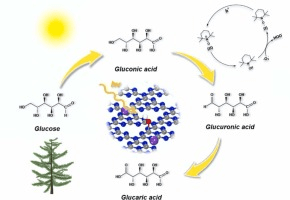
Biomass photorefining is a promising approach for sustainable clean energy and high-value chemical production. However, selectively converting glucose into glucaric acid, the most valuable derivative, still poses a significant challenge due to the difficulty in transforming the terminal hydroxyl group into a carboxy group. Here, we demonstrate that highly selective glucose photorefining into glucaric acid can be achieved by synergistically coupling alkalizing modification of polymeric carbon nitride (CN) with 2,2,6,6-tetramethylpiperidine-1-oxyl (TEMPO) mediation, which promotes the oxidation of the primary alcohol group attached to the C6 site of gluconic acid. Density functional theory (DFT) calculations affirm the enhanced performance of modified CN in glucaric acid production. When medicated with TEMPO, the optimized photocatalysis achieves ∼ 100 % glucose conversion and > 30 % glucaric acid yield, setting a record for photocatalytic glucaric acid production. This work showcases the significance of combining photocatalyst modification and redox mediation for inspiring high-efficiency photocatalysis systems for biomass photorefining.
Unveiling Carbon Cluster Coating in Graphene CVD on MgO: Combining Machine Learning Force field and DFT Modeling
ACS Appl. Mater. Interfaces 2024
In this study, we investigate the behavior of carbon clusters (Cn, where n ranges from 16 to 26) supported on the surface of MgO. We consider the impact of doping with common impurities (such as Si, Mn, Ca, Fe, and Al) that are typically found in ores. Our approach combines density functional theory calculations with machine learning force field molecular dynamics simulations. It is found that the C21 cluster, featuring a core–shell structure composed of three pentagons isolated by three hexagons, demonstrates exceptional stability on the MgO surface and behaves as an “enhanced binding agent” on MgO-doped surfaces. The molecular dynamics trajectories reveal that the stable C21 coating on the MgO surface exhibits less mobility compared to other sizes Cn clusters and the flexible graphene layer on MgO. Furthermore, this stability persists even at temperatures up to 1100K. The analysis of the electron localization function and potential function of Cn on MgO reveals the high localization electron density between the central carbon of the C21 ring and the MgO surface. This work proposes that the C21 island serves as a superstable and less mobile precursor coating on MgO surfaces. This explanation sheds light on the experimental defects observed in graphene products, which can be attributed to the reduced mobility of carbon islands on a substrate that remains frozen and unchanged.
Selective photocatalytic glucaric acid production from TEMPO-mediated glucose oxidation on alkalized carbon nitride
Applied Catalysis B: Environment and Energy, 2025
Biomass photorefining is a promising approach for sustainable clean energy and high-value chemical production. However, selectively converting glucose into glucaric acid, the most valuable derivative, still poses a significant challenge due to the difficulty in transforming the terminal hydroxyl group into a carboxy group. Here, we demonstrate that highly selective glucose photorefining into glucaric acid can be achieved by synergistically coupling alkalizing modification of polymeric carbon nitride (CN) with 2,2,6,6-tetramethylpiperidine-1-oxyl (TEMPO) mediation, which promotes the oxidation of the primary alcohol group attached to the C6 site of gluconic acid. Density functional theory (DFT) calculations affirm the enhanced performance of modified CN in glucaric acid production. When medicated with TEMPO, the optimized photocatalysis achieves ∼ 100 % glucose conversion and > 30 % glucaric acid yield, setting a record for photocatalytic glucaric acid production. This work showcases the significance of combining photocatalyst modification and redox mediation for inspiring high-efficiency photocatalysis systems for biomass photorefining.
Mechanochromic hydrogen-bonded cocrystals with a salient effect upon heating
Mater. Chem. Front., 2024, Advance Article
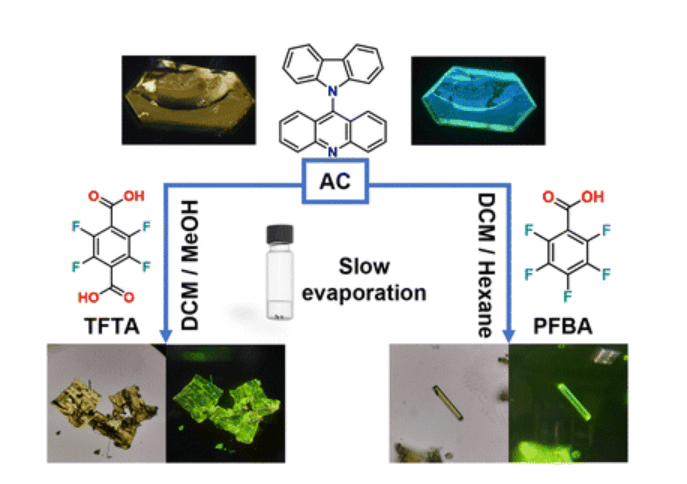
Herein, we report the characterization of two hydrogen-bonded cocrystals, termed AC-TFTA and AC-PFBA, with mechanofluorochromism upon grinding. The heating of single crystals of AC-TFTA promotes microscopic displacements due to a decarboxylation process, which was studied through calorimetry-based techniques, gas chromatography/mass spectrometry, and hot-stage microscopy. Using solid-state nuclear magnetic resonance (ssNMR), powder X-ray diffraction (PXRD), and UV-Vis/fluorescence spectroscopy, we demonstrated that AC-TFTA displays sharper photophysical changes than its analog AC-PFBA, attributable to differences in the energies of their non-covalent interactions. Furthermore, the reversibility of the amorphous phase in both cocrystals was explored. However, fatigue tests led us to conclude that AC-TFTA displays potential for application as an anticounterfeiting agent, in contrast with the more robust crystalline AC-PFBA. This work emphasizes the importance of cocrystallization in generating accessible and functional mechanofluorochromic materials.
Computational screening of metalloporphyrin catalysts for the activation of carbon dioxide
Molecular Catalysis 2024, in press
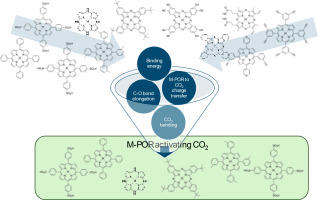
Electrocatalytic CO2 reduction (eCO2R) to value-added chemicals offers a promising route for carbon capture and utilization. Metalloporphyrin (M-POR) is a class of catalysts for eCO2R that has drawn attention due to its tuneable electronic and structural properties. This work presents a computational screening, based on density functional theory calculations, of one of the key steps in the eCO2R: the adsorption of CO2 on 110 M-PORs with varying peripheral ligands, metal centres, and oxidation states, to understand how these factors can influence CO2 activation. A set of criteria was used to shortlist M-PORs based on their ability to lengthen the C–O bond, bend the O–C–O angle, bind CO2, and donate charge from the metal of the M-POR to the carbon of CO2. 16 systems were selected for their potential to activate CO2. These systems predominantly have the electron configuration of the metal centre in the d[6] and d[7] configurations. Natural bond orbital analysis revealed the impact of electron-withdrawing groups in the system, which increases orbital splitting and, consequently, lowers the ability of the M-POR to activate CO2. Second-order perturbation theory analysis confirms that the presence of electron-donating groups in the ligand structure enhances CO2 activation. This work demonstrates the interconnected effect of peripheral ligands, metal centres, and oxidation states in M-PORs on their ability to adsorb and activate CO2, thereby establishing structure-activity relationships within M-PORs.
Experimentally Delineating the Catalytic Effect of a Single Water Molecule in the Photochemical Rearrangement of the Phenylperoxy Radical to the Oxepin-2(5H)-one-5-yl Radical
Catalysis plays a pivotal role in both chemistry and biology, primarily attributed to its ability to stabilize transition states and lower activation free energies, thereby accelerating reaction rates. While computational studies have contributed valuable mechanistic insights, there remains a scarcity of experimental investigations into transition states. In this work, we embark on an experimental exploration of the catalytic energy lowering associated with transition states in the photorearrangement of the phenylperoxy radical–water complex to the oxepin-2(5H)-one-5-yl radical. Employing matrix isolation spectroscopy, density functional theory, and post-HF computations, we scrutinize the (photo)catalytic impact of a single water molecule on the rearrangement. Our computations indicate that the barrier heights for the water-assisted unimolecular isomerization steps are approximately 2–3 kcal mol–1 lower compared to the uncatalyzed steps. This decrease directly coincides with the energy difference in the required wavelength during the transformation (Δλ = λ546 nm – λ579 nm ≡ 52.4–49.4 = 3.0 kcal mol–1), allowing us to elucidate the differential transition state energy in the photochemical rearrangement of the phenylperoxy radical catalyzed by a single water molecule. Our work highlights the important role of water catalysis and has, among others, implications for understanding the mechanism of organic reactions under atmospheric conditions.