All posts by crespootero

I am a computational chemist at University College London

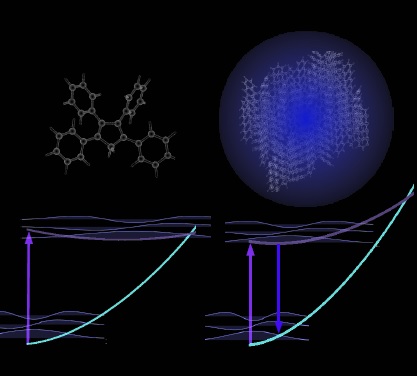
Understanding aggregation induced emission in a propeller-shaped blue emitter

ChemPhotoChem, 2019, Just Accepted, DOI:10.1002/cptc.201900075

Organic fluorophores with an enhanced emission in the condensed phase have great potential for the design of optoelectronic materials. Several propeller-shaped molecules show aggregation-induced emission (AIE), in particular, silole derivatives have attracted significant attention because of their significant quantum yields in the solid state. In this contribution, we investigate the mechanismof AIE of a propeller-shaped blue emitter: 1,2,3,4-tetraphenyl-1,3-cyclopentadiene (TPC). We explore the excited state mechanism in the light of models most commonly used to explain it: restriction of intramolecular motions (RIM) and restricted access to the conical intersection (RACI). Our interpretation is sup-ported by excited state dynamics simulations and the analysis of Huang-Rhysfactors and reorganisation energies. We quantify the effects of intermolecular interactions and exciton couplings. The mechanism for TPCis compared with previous investigations of analogue silole compounds. Our systematic investigation highlights the role of conical intersections on the nonradiative decay mechanisms and complementary descriptions provided by the RIM and RACI models.

ONIOM(QM:QM’) Electrostatic Embedding Schemes for Photochemistry in Molecular Crystals

J. Chem. Theory Comput., 2019, 15 (4), pp 2504–2516

Understanding photoinduced processes in molecular crystals is central to the design of highly emissive materials such as organic lasers and organic light-emitting diodes. The modelling of such processes is, however, hindered by the lack of excited state methodologies tailored for these systems. Embedding approaches based on the Ewald sum can be used in conjunction with excited state electronic structure methods to model the localised excitations which characterise these materials. In this article, we describe the implementation of a two-level ONIOM(QM:QM’) point charge embedding approach based on the Ewald method, the Ewald Embedded Cluster (EEC) model. An alternative self-consistent method is also considered to simulate the response of the environment to the excitation. Two molecular crystals with opposing photochemical behaviour were used to benchmark the results with single reference and multireference methods. We observed that the inclusion of an explicit ground state cluster surrounding the QM region was imperative for the exploration of the excited state potential energy surfaces. Using EEC, accurate absorption and emission energies as well as S1-S0 conical intersections were obtained for both crystals. We discuss the implications of the use of these embedding schemes considering the degree of localisation of the excitation. The methods discussed herein are implemented in an open source platform (fromage, https://github.com/Crespo-Otero-group/fromage) which acts as an interface between popular electronic structure codes (Gaussian, Turbomole and Molcas).

Exploring Potential Energy Surfaces for Aggregation‐Induced Emission ‐ from Solution to Crystal

AIE
Chem. Asian J. 2019, 14, 700-714.
Aggregation‐induced emission (AIE) is a phenomenon where non‐luminescent compounds in solution become strongly luminescent in aggregate and solid phase. It provides a fertile ground for luminescent applications that has rapidly developed in the last 15 years. In this review we centre on the contributions of theory and computations to understanding the molecular mechanism behind it. Starting from initial models, such as restriction of intramolecular rotations (RIR), and the calculation of non‐radiative rates with Fermi’s Golden Rule (FGR), we centre on studies of the global excited‐state potential energy surface that have provided the basis for the restricted access to a conical intersection (RACI) model. In this model, which has been shown to apply for a diverse group of AIEgens, the lack of fluorescence in solution comes from radiationless decay at a CI in solution that is hindered in the aggregate state. We also highlight how intermolecular interactions modulate the photophysics in the aggregate phase, in terms of fluorescence quantum yield and emission colour.

Water oxidation catalysed by quantum-sized BiVO4

BiVO4
J. Mat. Chem. A. 2018, 6, 24965-24970.
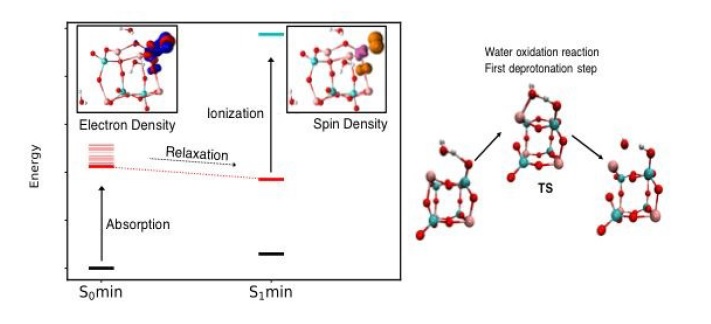
Bismuth vanadate (BiVO4) is one of the most promising materials for photoelectrochemical water splitting, with recent work highlighting the improved photocatalytic activity of quantum-sized BiVO4 compared with the crystalline phase. Herein, we report a theoretical investigation of the structural, optical and catalytic properties of BiVO4 clusters through a combination of density functional theory methods (ab initio molecular dynamics, time-dependent density functional theory, transition state theory). The enhanced solar water oxidation efficiency of BiVO4 nanoclusters is linked with the localization of spin density on the ionized cluster surface, and the dramatic reduction, compared with the crystalline BiVO4 phase, of the Gibbs free energy of activation and reaction associated with the hydrogen transfer process between water and BiVO4. Our results illustrate the main effects associated with the reduction of dimensions (from bulk to quantum-size) on the main steps of water oxidation mechanisms. This understanding can contribute to the design of efficient BiVO4 quantum-sized water-splitting photocatalysts.

Switching the Spin State of Pentafluoro phenylnitrene: Isolation of a Singlet Arylnitrene Complex

ja-2018-107927_0008
    J. Am. Chem. Soc., 140, 49, 17271-17277.
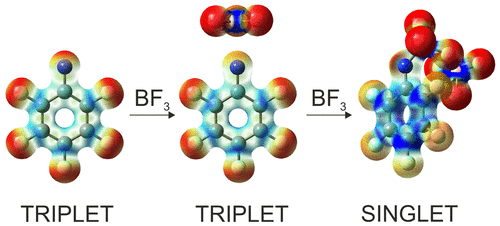
The chemistry of arylnitrenes is dominated by their triplet ground states and excited open-shell singlet states. This results in radical-type reactions and unwanted rearrangements which diminish the use of arylnitrenes as intermediates in organic synthesis. While the closed-shell singlet states of arylnitrenes are expected to undergo useful chemical transformations (comparable to the closed shell singlet states of carbenes), these states are too high in energy to be chemically accessible. When triplet pentafluorophenylnitrene is interacting with the Lewis acid BF3 under the conditions of matrix isolation, a Lewis acid-base complex consisting of the closed-shell singlet state of the nitrene and two molecules of BF3 is formed. Although the closed shell singlet state of pentafluorophenylnitrene is calculated (CCSD(T)) to lie more than 25
kcal/mol above its triplet ground state, the reaction with BF3 results in switching the spin state from triplet to singlet. The formation of the singlet complex was monitored by IR, UV-vis, and EPR spectroscopy. DFT, CCSD(T), and CASPT2 calculations confirm the experimental findings.

Aryne-Mediated Arylation of Hantzsch Esters: Access to Highly Substituted Arylhydropyridines

https://www.thieme-connect.de/media/synthesis/EFirst/i_z0578_ga_10-1055_s-0037-1611065.gif
Synthesis, 2018,50(23): 4591-4605  
This is a full account of our studies into the generation of highly functionalised 2-aryl-1,2-dihydropyridines and 2-methylene-3-aryl-1,2,3,4-tetrahydropyridines via intermolecular aryne ene reactions of Hantzsch esters. Furthermore, exposure to excess aryne revealed unusual 3′-aryl-spiro[benzocyclobutene-1,1′-(3′,4′-dihydropyridines)]. Mechanistic insights are provided by deuterium-labelling studies and DFT calculations, whilst preliminary cytotoxicity investigations reveal that the spirocycles are selective against colon carcinomas over ovarian cancer cell lines and that all the compounds have high selectivity indices with regards to non-cancer cells.

Biotin-tagged fluorescent sensor to visualize ‘mobile’ Zn2+ in cancer cells

chem comm
Chem. Commun., 2018, 54, 9619-9622
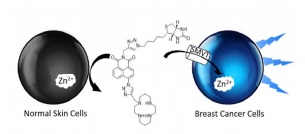
A cancer cell-targeting fluorescent sensor has been developed to image mobile Zn2+ by introducing a biotin group. It shows a highly selective response to Zn2+ in vitro, no toxicity in cellulo and images ‘mobile’ Zn2+ specifically in cancer cells. We believe this probe has the potential to help improve our understanding of the role of Zn2+ in the processes of cancer initiation and development.

Recent Advances and Perspectives on Nonadiabatic Mixed Quantum–Classical Dynamics

chemrev

Chem. Rev., 2018, 118, 7026–7068  (part of the Theoretical Modeling of Excited State Processes special issue). 
Nonadiabatic mixed quantum–classical (NA-MQC) dynamics methods form a class of computational theoretical approaches in quantum chemistry tailored to investigate the time evolution of nonadiabatic phenomena in molecules and supramolecular assemblies. NA-MQC is characterized by a partition of the molecular system into two subsystems: one to be treated quantum mechanically (usually but not restricted to electrons) and another to be dealt with classically (nuclei). The two subsystems are connected through nonadiabatic couplings terms to enforce self-consistency. A local approximation underlies the classical subsystem, implying that direct dynamics can be simulated, without needing precomputed potential energy surfaces. The NA-MQC split allows reducing computational costs, enabling the treatment of realistic molecular systems in diverse fields. Starting from the three most well-established methods—mean-field Ehrenfest, trajectory surface hopping, and multiple spawning—this review focuses on the NA-MQC dynamics methods and programs developed in the last 10 years. It stresses the relations between approaches and their domains of application. The electronic structure methods most commonly used together with NA-MQC dynamics are reviewed as well. The accuracy and precision of NA-MQC simulations are critically discussed, and general guidelines to choose an adequate method for each application are delivered.

How Inter- and Intramolecular Processes Dictate Aggregation-Induced Emission in Crystals

michael2

J. Phys. Chem. Lett., 2017, 8, 6148–6153
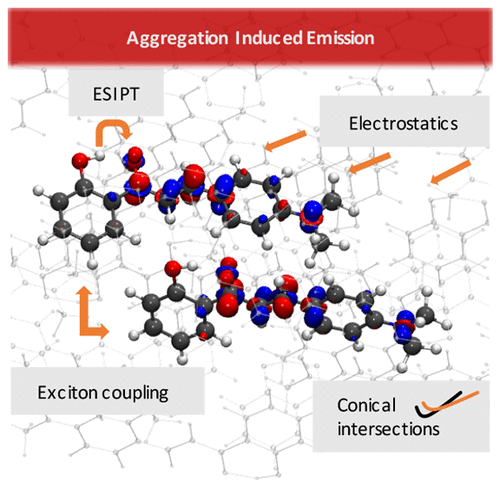
Aggregation-induced emission (AIE) offers a route for the development of luminescent technologies with high quantum efficiencies. Excited-state intramolecular proton transfer (ESIPT) coupled to AIE can produce devices with emission across the visible spectrum. We use a combination of theoretical models to determine the factors that mediate fluorescence in molecular crystals undergoing ESIPT. Using two materials based on 2′-hydroxychalcone as exemplar cases, we analyze how inter- and intramolecular processes determine the emissive properties in the crystal environment. This systematic investigation extends the current interpretation of AIE to polar chromophores with multiple decay pathways. We find that population of nonradiative pathways is dictated by the electronic effects of the substituents and the degree of distortion allowed in the crystal environment. Localization of the electron density is crucial to maximize fluorescence via ESIPT. Our conclusions offer design strategies for the development of luminescent molecular crystals.

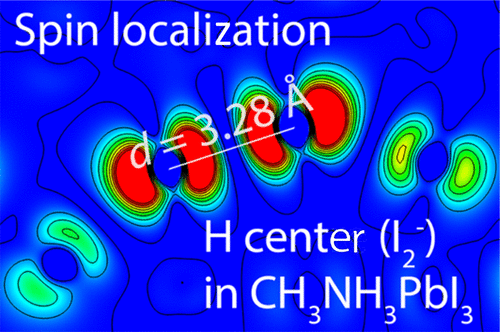
H-Center and V-Center Defects in Hybrid Halide Perovskites

Aron.gif

ACS Energy Lett., 2017, 2, 2713–2714
The self-trapping of holes with the formation of a molecular X2– anion is a well-established process in metal halide (MX) crystals, but V-center (2X– + h+ → X2–) and H-center (X– + Xi– + h+ → X2–) defects have not yet been confirmed in halide perovskite semiconductors. The I2– split-interstitial defect is predicted to be a spin radical in CH3NH3PbI3 with an optically excited state in the semiconductor band gap.