All posts by crespootero

I am a computational chemist at University College London

Protect to detect: A Golgi apparatus targeted probe to image mobile zinc through the use of a lipophilic cell-labile protecting group strategy

Sensors and Actuators B: Chemical. 2021, 338,129850.

The Golgi apparatus requires zinc for its normal function, but the role it plays in these processes at the sub-cellular level is not well-understood due to the lack of appropriate tools to image it. Herein, a small molecule Golgi apparatus targeted probe was developed to image mobile Zn2+. A trityl group was used to protect a Golgi apparatus targeting cysteine residue to increase cell membrane permeability, which was then removed within 24 h, revealing the free cysteine targeting motif to anchor the probe to the Golgi apparatus. The probe shows good photophysical properties, good selectivity and Zn2+ response over a wide range of pH as well as low cellular toxicity. The probe was shown to be capable of targeting the Golgi apparatus and responding to Zn2+ in a number of different cell lines and was also applied to monitor the change of concentration of mobile Zn2+ in the Golgi apparatus in response to oxidative stress.

Engineering the electronic and optical properties of 2D porphyrin paddlewheel metal-organic frameworks

JPhys Energy 2021, 3 034005

Metal organic frameworks (MOFs) are promising photocatalytic materials due to their high surface area and tuneability of their electronic structure. We discuss here how to engineer the band structures and optical properties of a family of two-dimensional (2D) porphyrin-based MOFs, consisting of M tetrakis(4 carboxyphenyl)porphyrin structures (M TCPP, where M = Zn or Co) and metal (Co, Ni, Cu or Zn) paddlewheel clusters, with the aim of optimising their photocatalytic behaviour in solar fuel synthesis reactions (water splitting and/or CO2 reduction). Based on density functional theory (DFT) and time-dependent DFT simulations with a hybrid functional, we studied three types of composition/structural modifications: a) varying the metal centre at the paddlewheel or at the porphyrin centre to modify the band alignment; b) partially reducing the porphyrin unit to chlorin, which leads to stronger absorption of visible light; and c) substituting the benzene bridging between the porphyrin and paddlewheel, by ethyne or butadiyne bridges, with the aim of modifying the linker to metal charge transfer behaviour. Our work offers new insights on how to improve the photocatalytic behaviour of porphyrin- and paddlewheel-based MOFs.

Role of Conical Intersections on the Efficiency of Fluorescent Organic Molecular Crystals

J. Phys. Chem. A 2021, 125, 4, 1012–1024

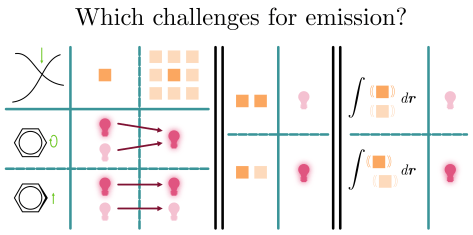
Organic molecular crystals are attractive materials for luminescent applications because of their promised tunability. However, the link between the chemical structure and emissive behavior is poorly understood because of the numerous interconnected factors which are at play in determining radiative and nonradiative behaviors at the solid-state level. In particular, the decay through conical intersection dominates the nonadiabatic regions of the potential energy surface, and thus, their accessibility is a telling indicator of the luminosity of the material. In this study, we investigate the radiative mechanism for five organic molecular crystals which display a solid-state emission, with a focus on the role of conical intersections in their photomechanisms. The objective is to situate the importance of the accessibility of conical intersections with regards to emissive behavior, taking into account other nonradiative decay channels, namely, vibrational decay, and exciton hopping. We begin by giving a brief overview of the structural patterns of the five systems within a larger pool of 13 crystals for a richer comparison. We observe that because of the prevalence of sheet like and herringbone packing in organic molecular crystals, the conformational diversity of crystal dimers is limited. Additionally, similarly spaced dimers have exciton coupling values of a similar order within a 50 meV interval. Next, we focus on three exemplary cases, where we disentangle the role of nonradiative decay mechanisms and show how rotational minimum energy conical intersections in vacuum lead to puckered ones in the crystal, increasing their instability upon crystallization in typical packing motifs. In contrast, molecules with puckered conical intersections in vacuum tend to conserve this trait upon crystallization, and therefore, their quantum yield of fluorescence is determined predominantly by other nonradiative decay mechanisms.

Organic room-temperature phosphorescence from halogen-bonded organic frameworks: hidden electronic effects in rigidified chromophores

Chem. Sci. 2021, Advance Article.

Development of purely organic materials displaying room-temperature phosphorescence (RTP) will expand the toolbox of inorganic phosphors for imaging, sensing or display applications. While molecular solids were found to suppress non-radiative energy dissipation and make the RTP process kinetically favourable, such an effect should be enhanced by the presence of multivalent directional non-covalent interactions. Here we report phosphorescence of a series of fast triplet-forming tetraethyl naphthalene-1,4,5,8-tetracarboxylates. Various numbers of bromo substituents were introduced to modulate intermolecular halogen-bonding interactions. Bright RTP with quantum yields up to 20% was observed when the molecule is surrounded by Br⋯O halogen-bonded network. Spectroscopic and computational analyses revealed that judicious heavy-atom positioning suppresses non-radiative relaxation and enhances intersystem crossing at the same time. The latter effect was found to be facilitated by the orbital angular momentum change, in addition to the conventional heavy-atom effect. Our results suggest the potential of multivalent non-covalent interactions for excited-state conformation and electronic control.

Aggregation Induced Emission in the Tetraphenylthiophene Crystal: The Role of Triplet States

J. Phys. Chem. C, 2020, 124, 32, 17752–17761

Propeller-shaped molecules have received much attention due to their enhanced emission in the condensed phase (Aggregation Induced Emission, AIE) and their potential use in optoelectronic devices. In this contribution, we examine the excited state mechanisms of tetraphenyl-thiophene (TPT), one member of the family which features weaker AIE. We perform a detailed analysis of the potential energy surfaces with special focus on the role of triplet states considering the crystal structure, intermolecular interactions, exciton couplings and reorganisation energies in the vacuum and solid state. In contrast to other members of the propeller-shaped family, nonradiative decay in TPT is driven by bond breaking. Because of the significant spin-orbit couplings along the reaction coordinate, intersystem crossing plays an important role in the mechanism. Our calculations show that aggregation in the solid state hampers the access to internal conversion pathways, however, intersystem crossing is active in the crystal phase, which explains the weak AIE of this molecule. This new understanding of the role of triplet states on the relaxation mechanisms of AIEgens has implications for the design of solid state highly-emissive materials based on TPT.

Molecular and Crystalline Requirements for Solid State Fluorescence Exploiting Excited State Intramolecular Proton Transfer

J. Mater. Chem. C, 2020. Accepted for publication. DOI: 10.1039/C9TC05717J

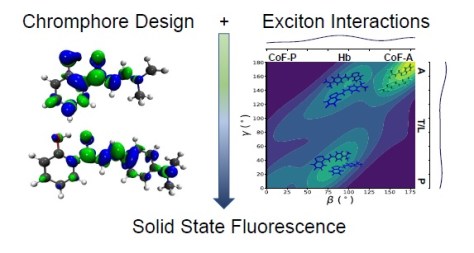
Aggregation induced emission offers a route to the development of emissive technologies based on solely organic systems. However, maximising fluorescence quantum efficiencies (QE) is a formidable challenge in attaining first-principles materials design, due to the interplay between the electronic structure of the chromophore and the morphology of the material. The identification of radiative and nonradiative channels, and how these are affected by aggregation, can rationalise emissive properties and aid in the design of yet more efficient fluorophores in the condensed phase. In the current work, we examine the mechanism behind the solid state luminescence enhancement in two related families of compounds with lasing properties, which undergo excited state intramolecular proton transfer (ESIPT). We systematically investigate competing excited state decay channels in a total of eleven crystals to evaluate the factors needed for efficient ESIPT fluorophores, aided by a full evaluation of the crystal structures, exciton coupling, and exciton hopping rates. We show that in addition to the restriction of nonradiative pathways, an efficient ESIPT is essential to maximise the QE in the solid state. This extensive study of structure-property relationships for fluorophores based on the ESIPT mechanism bridges the understanding of molecular photophysics with crystal structure, accelerating the development of highly efficient solid state emitters.

fromage: A library for the study of molecular crystal excited states at the aggregate scale

Journal of Computational Chemistry. 2020. Accepted for publication. DOI: 10.1002/jcc.26144

The study of photoexcitations in molecular aggregates faces the twofold problem of the increased computational cost associated with excited states and the complexity of the interactions among the constituent monomers. A mechanistic investigation of these processes requires the analysis of the intermolecular interactions, the effect of the environment, and 3D arrangements or crystal packing on the excited states. A considerable number of techniques have been tailored to navigate these obstacles; however, they are usually restricted to in‐house codes and thus require a disproportionate effort to adopt by researchers approaching the field. Herein, we present the FRamewOrk for Molecular AGgregate Excitations (fromage), which implements a collection of such techniques in a Python library complemented with ready‐to‐use scripts. The program structure is presented and the principal features available to the user are described: geometrical analysis, exciton characterization, and a variety of ONIOM schemes. Each is illustrated by examples of diverse organic molecules in condensed phase settings. The program is available at https://github.com/Crespo-Otero-group/fromage.

Endoplasmic reticulum targeting fluorescent probes to image mobile Zn2+

Chem. Sci. 2019. Accepted Manuscript. DOI: 10.1039/C9SC04300D

Zn2+ plays an important role in the normal function of the endoplasmic reticulum (ER) and its deficiency can cause ER stress, which is related to a wide range of diseases. In order to provide tools to better understand the role of mobile Zn2+ in ER processes, the first custom designed ER-localised fluorescent Zn2+ probes have been developed through the introduction of a cyclohexyl sulfonylurea as an ER-targeting unit with different Zn2+ receptors. Experiments in vitro and in cellulo show that both probes have a good fluorescence switch on response to Zn2+, high selectivity over other cations, low toxicity, ER-specific targeting ability and are efficacious imaging agents for mobile Zn2+ in four different cell lines. Probe 6 has been used to detect mobile Zn2+ changes under ER stress induced by both tunicamycin or thapsigarin, which indicates that the new probes should allow a better understanding of the mechanisms cells use to respond to dysfunction of zinc homeostasis in the ER and its role in the initiation and progression of disease to be developed.

An alternative modular ‘click-SNAr-click’ approach to develop subcellular localised fluorescent probes to image mobile Zn2+

Org. Biomol. Chem., 2019, Accepted Manuscript. DOI: 10.1039/C9OB01855G. (This article is part of the themed collection: The Mechanisms of Supramolecular Chemistry)

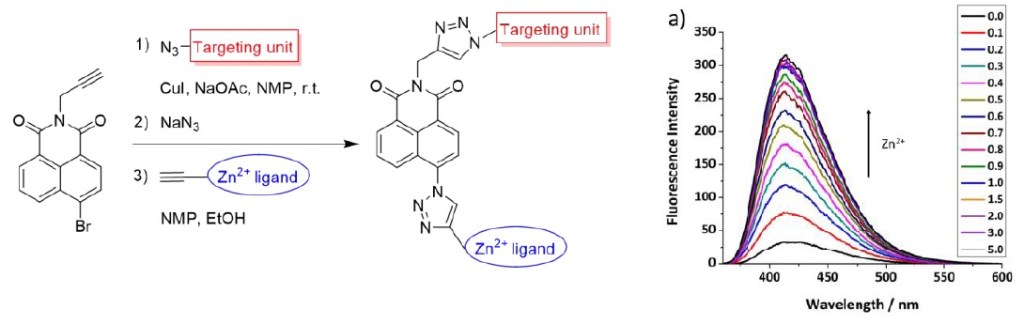
Zn2+ is involved in a number of biological processes and its wide-ranging roles at the subcellular level, especially in specific organelles, have not yet been fully established due to a lack of tools to image it effectively. We report a new and efficient modular double ‘click’ approach towards a range of sub-cellular localised probes for mobile zinc. Through this methodology, endoplasmic reticulum, mitochondria and lysosome localised probes were successfully prepared which show good fluorescence responses to mobile Zn2+ in vitro and in cellulo whilst a non-targeting probe was synthesized as a control. The methodology appears to have wide-utility for the generation of sub-cellular localised probes by incorporating specific organelle targeting vectors for mobile Zn2+ imaging.

Ultrafast photo-induced dynamics of 1,3-cyclohexadiene using XMS-CASPT2 surface hopping

J. Chem. Theory Comput. 2019, 15, 7, 3929-3940

A full-dimensional simulation of the photo-dissociation of 1,3-cyclohexadiene in the manifold of three electronic states was performed via non-adiabatic surface hopping dynamics using extended multi-state complete active space second-order perturbation (XMS-CASPT2) electronic structure theory with fully analytic non-adiabatic couplings. With the 47±8% product quantum yield calculated from the 136 trajectories, generally 400 fs-long, and an estimated excited lifetime of 89±9 fs, our calculations provide a detailed description of the non-adiabatic deactivation mechanism, showing the existence of an extended conical intersection seam along the reaction coordinate. The nature of the preferred reaction pathways on the ground state is discussed and extensive comparison to the previously published full dimensional dynamics calculations is provided.