
J. Phys. Chem. C 2022, Just Accepted
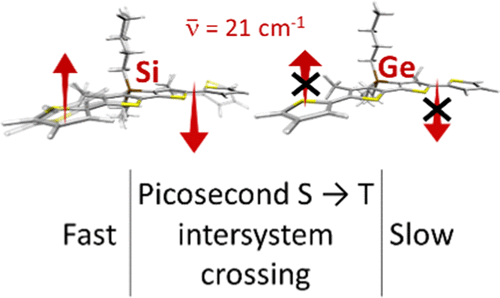
The effect of incorporating Si and Ge atoms in the conjugated backbone of semiconductor polymers is investigated using transient absorption spectroscopy and quantum chemical calculations to uncover the heavy-atom impact on the excited-state dynamics in neat films and polymer/fullerene blends. The singlet and triplet exciton dynamics of the copolymers are resolved and the time constant of intersystem crossing (ISC) of dithienosilole is found to be 6.98 ± 0.45 ps and nearly 4 times longer than that of dithienogermole. This result indicates that factors other than the heavy-atom effect govern the ISC rates and the overall excited-state dynamics in the copolymers. Our quantum chemical calculations and estimates of the ISC rates based on the semiclassical derivation for the electron-transfer processes in the nonadiabatic limit reveal that the main driver for the increased ISC time constant in BuSiDT is the reduction in planarity and increased torsional out-of-plane vibration of the Si-bridged thiophenes in the dithienosilole compared to the dithienogermole, leading to 8.3 times higher spin–orbit coupling and consequently a higher ISC rate. In the polymer/fullerene blends, charge generation yields are estimated. The results from this study indicate that the incorporation of heavy atoms in a bridge position within the conjugated polymer backbone can be used as a synthetic strategy to fine-tune excited-state properties.
 The Crespo-Otero Research Group